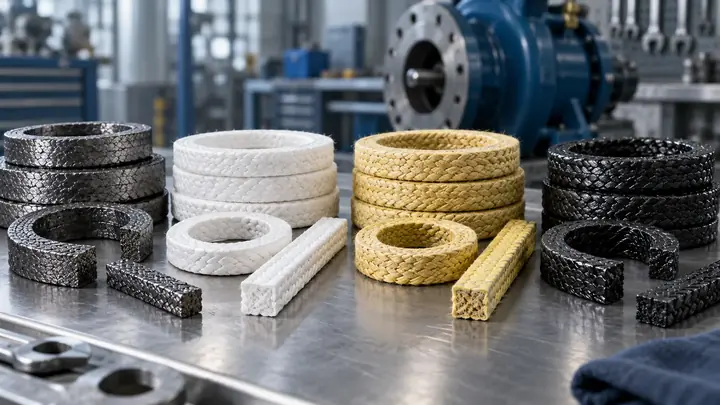
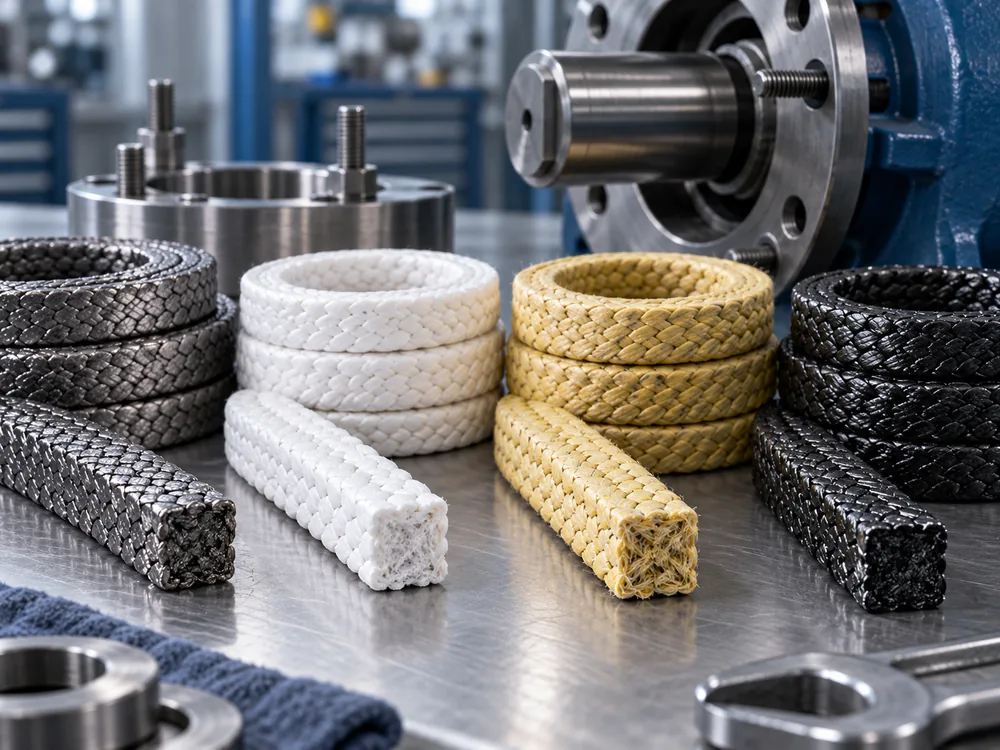
Pump packing material sets the basic limits for chemical compatibility, friction, heat handling, abrasion resistance and shaft or sleeve wear. Graphite and carbon favor heat transfer; PTFE/ePTFE favors low friction and broad chemical resistance; aramid adds strength where solids and extrusion are concerns.
MATERIAL BASICS
WHAT THE PACKING MATERIAL ACTUALLY CONTROLS
Inside a packed stuffing box, the selected material governs how the ring set behaves under compression and continuous rubbing contact. It determines how readily the packing conforms to the shaft or sleeve, carries gland load, transfers frictional heat, resists fluid attack and survives abrasive solids or extrusion forces.
The base fiber also changes how the rings respond to gland load. Soft graphite and expanded PTFE conform readily to small surface irregularities, while carbon and aramid fibers provide a more stable structure where higher mechanical strength is needed. That difference affects run-in, leakage control and how evenly the packing bed carries load.
Impregnants and lubricants modify the base material rather than replace it. PTFE dispersions can reduce friction and improve chemical resistance; graphite additions can improve heat transfer and lubricity; blocking agents can reduce fluid penetration through the braid. The finished packing is therefore a system of fiber, braid construction and treatment.
Material choice also affects shaft-sleeve life. Low-friction fibers are generally gentler on the rotating surface, while very strong abrasive-resistant fibers can concentrate wear if they are used in the wrong position or allowed to run dry. Hybrid packings often use different yarns at the corners and faces to balance strength, sealing and sleeve protection.
Selection starts with chemistry, temperature, shaft surface speed, stuffing-box pressure, solids content and cleanliness requirements. Those conditions determine which material families are realistic before braid style, ring size and installation details are considered.
FIBER FAMILIES
COMMON COMPRESSION PACKING MATERIALS FOR PUMPS
G
Graphite
Very low friction and strong heat-transfer capability make graphite-based packing a common choice for hot or faster rotating service. Flexible graphite also conforms well under gland load.
Check: oxidizing chemistry, product contamination restrictions and the exact binder or carrier system.
C
Carbon fiber
Carbon-fiber yarn gives strength, dimensional stability and good heat handling. It is often used where a tougher, more structured braid is wanted than soft graphite alone.
Check: shaft or sleeve condition, fiber treatment and whether the process chemistry is strongly oxidizing.
P
PTFE / ePTFE
PTFE offers low friction and broad chemical resistance. Expanded PTFE is more conformable than dense conventional PTFE and is widely used in chemical and clean-service packing.
Check: frictional heat, thermal expansion or consolidation, and whether fillers or lubricants are acceptable.
A
Aramid / para-aramid
High tensile strength and abrasion resistance make aramid useful in slurry service, extrusion-resistant end rings and reinforced corners.
Check: a full hard-aramid set can be aggressive to sleeves when surface finish, hardness or gland loading is poor.
S
Acrylic & synthetic fibers
Acrylic and other engineered yarns can provide resilient, conformable and economical packing for water, utilities and moderate process duties.
Check: polymer family matters—chemical and temperature limits cannot be inferred from “synthetic” alone.
R
Ramie, flax & plant fibers
Lubricated plant-fiber packings remain useful in water and low-to-moderate duty where resilience, conformability and tolerance of imperfect equipment are valued.
Check: lower temperature and chemical capability than modern graphite, PTFE or carbon-fiber designs.
H
Hybrid materials
Hybrid braids combine materials to separate functions—for example a low-friction running surface with aramid reinforcement against extrusion or abrasive loading.
Check: judge the complete braid and contact surface, not the strongest fiber named in the product description.
COMPARISON
MATERIAL TENDENCIES IN ROTATING PUMP SERVICE
Material family
Friction & heat
Strength / abrasion
Typical selection direction
Graphite
Very low friction; strong heat transfer
Moderate unless reinforced
Hotter or faster rotating duty when chemistry permits
Carbon fiber
Low friction; good thermal stability
Good structure and wear resistance
Demanding general process service and higher thermal load
PTFE / ePTFE
Low friction; less forgiving of trapped heat than graphite
Varies from soft/conformable to dense/reinforced
Chemical resistance or clean/graphite-free service
Aramid
Higher rubbing friction than PTFE/graphite
Very high abrasion and extrusion resistance
Slurry, solids, end rings or reinforced corners
Acrylic / synthetic
Moderate; depends strongly on lubricant
Moderate and resilient
Water, utility and moderate process service
Ramie / flax
Lubricant-dependent, generally moderate duty
Conformable; tolerates imperfect equipment
Water and traditional utility applications
MATERIAL DIFFERENCES
GRAPHITE, CARBON AND PTFE ARE NOT INTERCHANGEABLE NAMES
Graphite vs carbon fiber
Both are carbon-based, but the packing behavior is different. Flexible graphite emphasizes low friction, conformability and heat transfer. Carbon-fiber yarn emphasizes structure and tensile strength. A carbon-fiber braid can also be impregnated with graphite or PTFE, so the label on the yarn does not describe the whole packing.
PTFE vs graphite-filled PTFE
Pure PTFE/ePTFE is selected when broad chemical resistance and low friction are priorities. Adding graphite changes thermal behavior and normally removes the “graphite-free” advantage. A filled PTFE braid must therefore be checked against contamination rules as well as chemistry.
Aramid as reinforcement
Aramid does not have to occupy the entire ring. Reinforced corners or end rings can resist extrusion and abrasive attack while a lower-friction material runs against the sleeve. This is often a better balance than specifying maximum aramid content everywhere.
SELECTION LOGIC
HOW TO CHOOSE A PUMP PACKING MATERIAL
Choose the material from the service envelope, not from a generic “best packing” ranking. First eliminate chemically incompatible fibers and treatments; then check temperature, shaft surface speed, stuffing-box pressure, solids, sleeve condition and contamination limits. Only after those checks should cost or brand preference decide between suitable products.
Shaft surface speed is v = πDN / 60 when shaft diameter D is in metres and speed N is in rpm. Surface speed matters because two pumps at the same rpm can generate very different rubbing conditions when shaft diameters differ.
After the material family is narrowed, verify the required packing construction. Material and construction work as one sealing system.
1
Define the fluidRecord chemistry, concentration, suspended solids, cleaners and credible upset conditions.
2
Set the temperature envelopeUse operating and maximum temperature; note oxidizing service where graphite or carbon may need extra scrutiny.
3
Calculate shaft surface speedUse actual shaft or sleeve diameter and rpm, not rpm alone.
4
Use stuffing-box pressureDo not automatically substitute pump discharge pressure for pressure at the packing set.
5
Rate abrasion and extrusion riskSolids, clearances and pressure can justify aramid or other reinforced elements.
6
Check the shaft or sleeveSurface finish, hardness, runout and existing wear affect how aggressive a packing can be.
7
Apply cleanliness rulesExclude fibers, pigments, oils or lubricants that cannot enter the process.
8
Verify the exact styleConfirm manufacturer limits for chemistry, temperature, pressure, speed and equipment type.
SERVICE DIRECTION
WHERE EACH MATERIAL FAMILY USUALLY ENTERS THE SHORTLIST
Hot / faster shaftGraphite or carbon-based styles often move up the list because frictional heat must leave the interface efficiently.
Broad chemical dutyPTFE/ePTFE is a common starting point when chemical compatibility and low friction dominate.
Abrasive slurryAramid reinforcement or hybrid packings can add strength without putting the hardest yarn against the sleeve everywhere.
Clean / graphite-freeUnfilled PTFE or another approved clean-service material may be preferred when carbonaceous contamination is prohibited.
Water / utilitySynthetic, acrylic or plant-fiber styles can be economical where temperature, chemistry and surface speed are moderate.
COMPATIBILITY
WHY A SINGLE pH NUMBER IS NOT ENOUGH
A broad pH range is useful for screening, but it cannot prove chemical compatibility. Concentration, temperature, oxidizers, solvents and additives can change the result, and the lubricant or impregnation may have narrower limits than the base fiber.
Check the complete packing
Fiber, filler, dispersion, lubricant and binder all contact the process or the shaft interface.
Check temperature with chemistry
A material that is stable at a temperature in one environment may have a lower practical limit in an oxidizing or reactive fluid.
Check cleaning and upset fluids
Short exposure during CIP, flushing or an upset can be more aggressive than the normal process stream.
SELECTION ERRORS
COMMON MATERIAL-SELECTION MISTAKES
Choosing by fiber name alone
Construction, impregnation, lubricant and density can change performance within the same material family.
Using discharge pressure
Packing sees stuffing-box pressure, which depends on pump design and operating point.
Ignoring surface speed
RPM without shaft diameter does not describe the rubbing speed at the packing interface.
Using full aramid for every slurry
More abrasion resistance can also mean more sleeve wear; reinforced hybrids may give a better balance.
Treating PTFE as thermally neutral
Low friction helps, but trapped heat and thermal expansion still matter in rotating service.
Trusting pH alone
Oxidizers, solvents, concentration and temperature can invalidate a simple pH-based choice.
RELATED REFERENCEPACKING TYPES
Match material choice to braid, formed-ring and hybrid construction.