
Box bore
The internal diameter of the stuffing box defines the outside diameter of the packing set. Corrosion, deposits or wear can affect the available space and ring seating.
Measure on a clean bore and check for taper or localized damage.STUFFING BOX HARDWARE
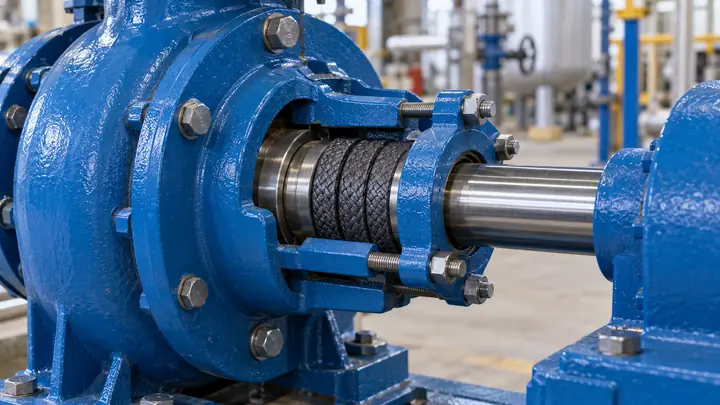
A pump stuffing box is the chamber that holds compression packing around a rotating shaft or sleeve. Correct sealing depends on the box bore, shaft or sleeve diameter, packing cross-section, gland-follower alignment, lantern-ring position and the condition of the flush path.
FUNCTION
Inside the stuffing box, the gland follower applies axial force to the packing rings. The rings expand radially against the shaft or sleeve and the box bore, creating the controlled restriction that limits leakage.
The chamber geometry determines the packing cross-section, available ring count, gland-follower engagement and the final position of any lantern ring. A flush connection can supply clean fluid for cooling, lubrication or solids exclusion, but the port has to communicate with the lantern-ring groove after the packing set is seated and compressed.
Box condition directly affects sealing. A new packing set cannot compensate for a grooved sleeve, excessive runout, a damaged bore, a cocked follower or an obstructed flush path. These faults alter contact pressure, heat and leakage regardless of packing material.
On the process side, the chamber may open directly into the pump casing or use a throat or restriction bushing. The bushing limits process fluid and solids entering the box and, in some designs, reduces packing-ring count or external-flush demand. Because it occupies axial space, it changes usable box depth, lantern-ring position and gland-follower engagement. Measure these dimensions on the assembled box.
GEOMETRY
Measure the actual hardware during maintenance. Wear, replacement sleeves, deposits and previous modifications can change the dimensions that the new packing has to fit.
The internal diameter of the stuffing box defines the outside diameter of the packing set. Corrosion, deposits or wear can affect the available space and ring seating.
Measure on a clean bore and check for taper or localized damage.The rotating diameter defines the inside diameter of the packing. A replaceable sleeve is common because packing wear is easier to manage on a sleeve than on the shaft itself.
Inspect for grooves, scoring, corrosion and runout before repacking.For conventional square packing, nominal cross-section equals half the difference between box bore and shaft or sleeve diameter.
Cross-section = (box bore − shaft/sleeve diameter) ÷ 2.Depth determines how many rings and components can fit while leaving enough engagement for the gland follower.
Count the lantern ring and any engineered end rings when checking set height.The follower needs enough insertion and future adjustment range to compress the set while remaining square to the shaft.
A follower near the end of its travel can indicate the wrong set height or worn packing.The port must communicate with the lantern-ring groove after the packing is seated and compressed.
Measure from a fixed box reference, not from an uncompressed loose ring stack.HARDWARE CHECK
| Condition | Likely effect | Inspection | Response |
|---|---|---|---|
| Grooved sleeve | Persistent leakage and packing damage | Visual and dimensional sleeve check | Repair or replace the worn surface before relying on new packing |
| Damaged or dirty bore | Uneven ring seating and local compression | Clean and inspect the full bore circumference | Remove deposits and correct damage that prevents the packing outside diameter from seating evenly |
| Follower cocked | Uneven compression and heat | Compare gland-nut position and follower gap | Correct alignment and tighten evenly |
| Blocked flush | Heat, solids ingress or poor lubrication | Verify the complete flush path | Restore flow and confirm lantern-ring alignment |
| Excessive runout | Cyclic opening, leakage and wear | Check shaft/sleeve movement to equipment limits | Correct the mechanical condition before repeated repacking |
| Wrong packing size | Poor fit, folding or inadequate compression | Measure bore and shaft/sleeve | Use the measured cross-section and the specified packing size |
PACKING STACK
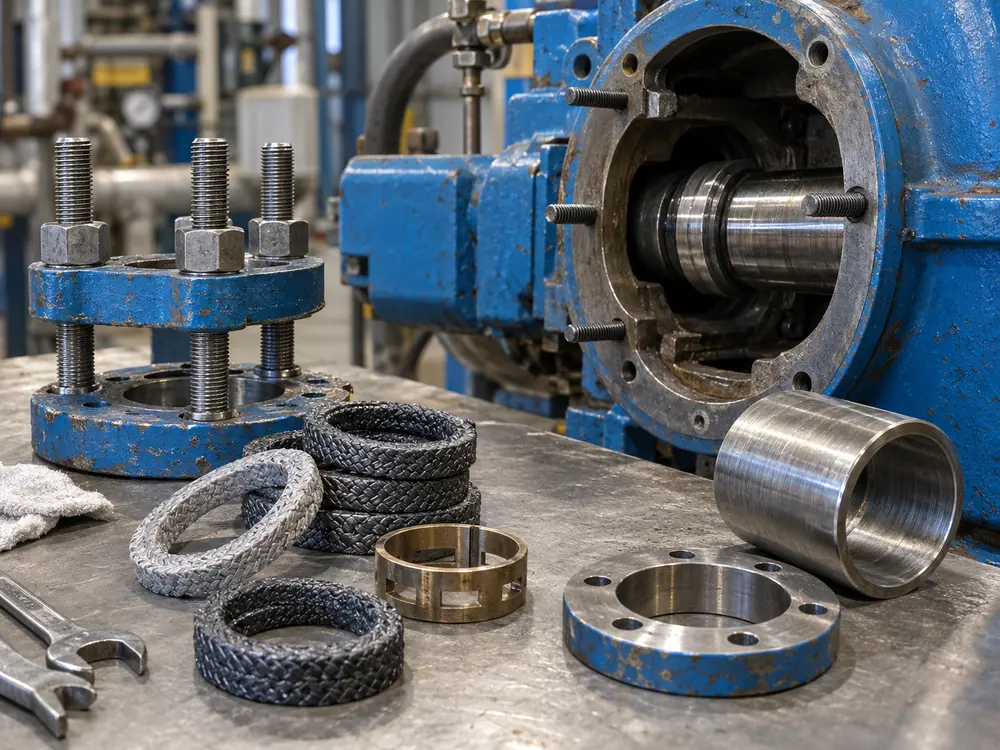
In a common packed-pump arrangement, the process-side end supports the inboard packing rings, a lantern ring divides the set where an external flush is used, and the gland follower loads the outboard end. The stack must fill the annular section, place the lantern ring at the flush port and leave enough follower travel for run-in and later adjustment.
A packed stuffing box and a mechanical-seal chamber use different geometry. Packing depends on radial packing space, available axial depth and follower geometry, while a seal chamber provides working space for mechanical-seal hardware. After a conversion, sleeve change or restriction-bushing retrofit, size the packing from the measured bore, shaft or sleeve diameter, depth and gland arrangement.
The bottom or throat end supports the inboard ring. Engineered restriction or throat bushings can reduce process ingress, packing-ring count or flush demand in suitable arrangements.
When a lantern ring is used, its annular groove belongs at the flush connection after the rings have been seated and the set has taken its initial compression.
The follower must enter squarely, load the ring set evenly and retain enough travel for run-in and later adjustment without bottoming on the box or hardware.
LANTERN RING
A lantern ring creates an annular distribution space around the shaft or sleeve. External flush enters through the stuffing-box port into this groove and distributes around the circumference. In abrasive or dirty service, the clean-fluid path helps keep process solids away from the rubbing interface.
Because the packing shortens as the gland is loaded, the lantern-ring position can shift during installation. Position it so the final compressed set—not merely the loose stack—communicates with the flush port.
Where an external flush excludes process fluid, set its pressure relative to the local stuffing-box pressure, not automatically to pump discharge pressure. Too little differential lets process fluid or solids enter the packing; excessive flush pressure increases leakage, water use and process dilution.
Flush quality and continuity are as important as pressure. Solids in the flush, interrupted flow or a blocked path to the lantern-ring groove accelerate packing and sleeve wear. A throat or restriction bushing can reduce process ingress and flush demand, provided the flush still reaches the packing interface and the gland retains enough travel for later adjustment.