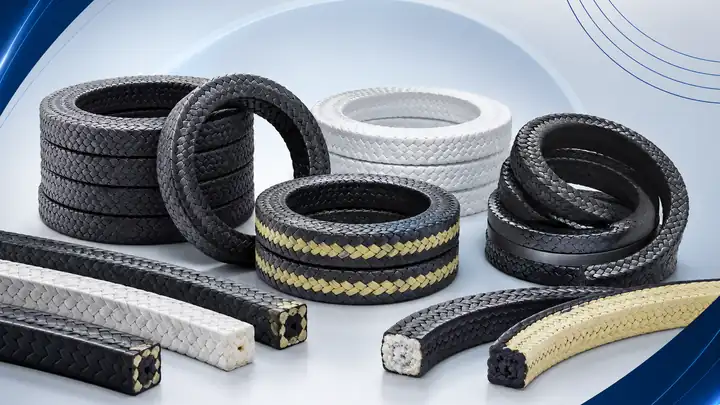
Pump packing is commonly described by braid construction and supply form. Square braid, interbraid or diagonal braid, braid-over-braid and braid-over-core describe how the packing body is built; spool stock, cut rings and die-formed or precompressed rings describe how it is supplied. Material then determines much of the chemical, temperature, friction and abrasion performance.
CLASSIFICATION
HOW PUMP PACKING TYPES ARE CLASSIFIED
A packing's construction describes how yarns or sealing material are formed into the finished packing. A packing's material describes what those yarns or sealing elements are made from. The two should not be treated as the same specification.
For example, two packings can both use PTFE-based yarn while using different braid constructions, densities, lubricants or corner reinforcement. Conversely, the same braid geometry can be produced from graphite, carbon, aramid, PTFE or other fibers. That is why pump selection should consider construction and packing material separately.
In rotating pumps, braided square-section packing remains the conventional form because individual rings can be cut, installed and compressed radially around a shaft or sleeve. Formed rings and engineered multi-material sets are used where controlled density, repeatability or a specific sealing function is required.
BRAID & FORM
COMMON PUMP PACKING CONSTRUCTIONS AND FORMS
No construction is automatically best for every pump. The useful differences are density, flexibility, dimensional stability, lubricant retention and how well the packing tolerates speed, pressure, shaft condition and solids.
Square braid
Strands pass over and under parallel strands to produce a comparatively soft, conformable packing, normally supplied in square cross-section. It can carry substantial lubricant and is often gentle on older or worn equipment.
Typical fit: lower-pressure rotary service where flexibility and conformability matter.
Interbraid / diagonal braid
Yarns cross diagonally through the packing body, creating an integrated structure with relatively even density. This construction resists unraveling and is widely suited to rotating equipment when a stable but flexible ring is needed.
Typical fit: general centrifugal-pump and agitator service across a broad range of materials.
Braid-over-braid
Successive braided jackets are built over one another until the required section is reached. The result is relatively dense and dimensionally firm compared with softer braid forms.
Typical fit: slow-speed or higher-pressure duties; not automatically the first choice for fast pump shafts.
Braid-over-core
One or more braided jackets surround a core that may be extruded, twisted, wrapped or otherwise formed. Changing the core and jacket allows manufacturers to tune density, resilience and cross-section behavior.
Typical fit: applications needing a particular balance of body strength and conformability.
Die-formed / precompressed rings
This is a supply form rather than a braid pattern. Packing is supplied as pre-cut, die-formed or precompressed rings instead of being cut only from spool stock during installation. Correctly specified rings can improve dimensional repeatability and reduce variation in field preparation.
Typical fit: engineered ring sets where repeatable dimensions and installed density are important.
Hybrid / corner-reinforced packing
Different yarns or structures are combined within one packing section. A common approach uses stronger corner yarns around a lower-friction body so the packing can resist abrasion while limiting friction against the sleeve.
Typical fit: slurry, abrasive or mechanically demanding service where one material alone is a compromise.
TERMS THAT GET CONFUSED
BRAID CONSTRUCTION IS NOT THE SAME AS CROSS-SECTION
A packing can have a square outside cross-section without being made by the square-braid method. Cross-section describes the finished external shape that fits the stuffing-box radial space; braid construction describes how the yarns or jackets are built inside that shape. This distinction matters when comparing product data sheets.
Cross-section answers: “What size fits the box?”
Most pump packing is supplied with a square cross-section because the ring must fill the radial space between the shaft or sleeve and the stuffing-box bore. A 10 mm square packing, for example, refers to its finished section size, not automatically to its braid pattern.
Determined from stuffing-box bore and shaft or sleeve diameter.
Controls whether the ring physically fills the available radial space.
Wrong section size causes installation and adjustment problems regardless of yarn quality.
Construction answers: “How is that section built?”
Square braid, diagonal/interbraid, braid-over-braid and braid-over-core describe the internal path of yarns or jackets. These methods influence density, flexibility, stability, lubricant retention and how readily the packing conforms when the gland is tightened.
The same nominal section size can be produced using different constructions.
The same construction can be made from very different fiber materials.
Construction alone never defines the final temperature, chemical or speed limit.
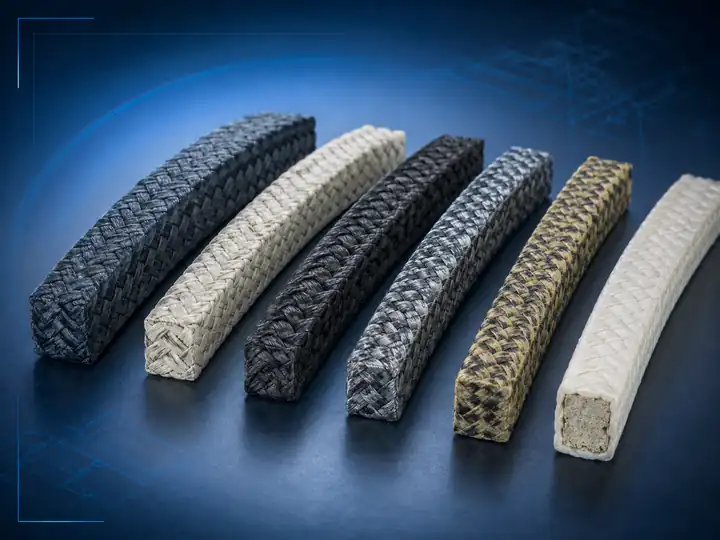
Braided packing constructions: a neutral product-style view that helps show how different braided forms can share a square outside section while varying in braid pattern, density and surface finish.
WHY CONSTRUCTION MATTERS
WHAT THE BRAID OR RING FORM ACTUALLY CHANGES
The construction mainly changes the mechanical behavior of the packing body. Material chemistry still governs many service limits, but construction affects how that material behaves while being installed, compressed and run against a shaft.
ConformabilitySofter structures can accommodate small surface or dimensional irregularities more readily, while denser structures tend to hold their shape more strongly.
Density and stabilityMore integrated or precompressed constructions can produce a more repeatable body density and reduce variation from one installed ring to the next.
Lubricant retentionThe internal void structure affects how lubricant or blocking agents are distributed and retained. This is one reason two visually similar packings may run differently.
Extrusion resistanceDense bodies, reinforced corners or harder end rings can help control extrusion, but excessive hardness can increase shaft or sleeve wear if the style is poorly matched.
COMPARISON
WHAT CHANGES BETWEEN PACKING CONSTRUCTIONS AND FORMS?
These are broad construction tendencies, not universal operating limits. Actual pressure, temperature, speed and chemical limits come from the specific packing style and manufacturer.
Type / form
General character
Where it can help
Main selection caution
Square braid
Soft and conformable
Worn equipment, lower-pressure rotary duty
Softness does not compensate for excessive runout or a damaged sleeve
Interbraid / diagonal
Integrated, stable and flexible
Broad centrifugal-pump service
Performance still depends strongly on yarn material, lubrication and density
Braid-over-braid
Dense and comparatively firm
Slow-speed, higher-pressure duties
Dense construction can be unsuitable where a pump needs greater conformability or lower friction
Braid-over-core
Core and jacket can tune resilience
Specialized cross-section or density requirements
The core material and jacket design matter as much as the construction name
Die-formed rings
Controlled ring size and density
Engineered sets and repeatable installation
Inside diameter, outside diameter and set height must match the stuffing box
Hybrid packing
Combines different properties
Abrasive or difficult pump service
Hard reinforcing fibers can increase sleeve wear if the style is misapplied or over-tightened
SERVICE DUTY
PUMP PACKING TYPES BY APPLICATION NEED
Packing is also grouped by service duty. Abrasive slurry, chemical exposure, high shaft surface speed and contamination limits can require different construction and material choices; the specific product limits still govern.
General serviceWater and moderate process duties where balanced friction, leakage control and cost are the main goals.
Abrasive / slurryHigher-strength or reinforced styles intended to resist solids, extrusion and mechanical wear.
Chemical serviceChemically resistant materials and treatments selected for the process fluid and temperature.
High-speed / low-frictionStyles designed around lower friction and better heat dissipation at elevated shaft surface speed.
Clean / contamination-sensitivePackings chosen to avoid graphite, color transfer, prohibited lubricants or other process contaminants.
SELECTION LOGIC
WHICH TYPE SHOULD A CENTRIFUGAL PUMP USE?
Start with the equipment and service, not with the construction name. Interbraided packing is common in centrifugal-pump service, but slurry, a worn sleeve, aggressive chemistry, high shaft surface speed or unusual stuffing-box pressure can change the preferred construction and material.
Check the actual stuffing-box dimensions and operating conditions before comparing products. The same nominal pump can operate under very different conditions depending on process fluid, speed, flush arrangement and shaft condition.
After selecting the construction family, use the materials guide to narrow fiber chemistry and friction behavior, then verify sizing and installation requirements.
1
Identify the equipmentCentrifugal pump, reciprocating equipment, mixer or another shaft duty. Do not assume a packing intended for a valve stem behaves the same on a rotating shaft.
2
Calculate shaft surface speedShaft diameter and rpm determine rubbing speed and strongly affect frictional heat.
3
Define the fluid and solidsChemistry, abrasiveness, solids concentration, lubricity and contamination limits guide the material and reinforcement choice.
4
Use stuffing-box pressureSelection should use pressure at the stuffing box, not automatically the pump's discharge pressure.
5
Inspect the hardwareSleeve finish, runout, box condition, gland alignment and flush arrangement can rule out otherwise suitable packing.
SUPPLY FORM
SPOOL STOCK OR DIE-FORMED RINGS?
Supply form changes how much sizing and ring preparation is done in the field. Spool stock gives maintenance teams flexibility to cut rings for different shaft sizes. Die-formed or precompressed rings are supplied closer to the required geometry and density, which can reduce installation variation when the dimensions are specified correctly.
Spool stock
Continuous braided packing is cut into individual rings at the job site. It is useful where one packing size serves several pieces of equipment or where maintenance needs flexibility.
Requires accurate cutting to shaft or mandrel circumference.
Joint quality and ring length depend on installer technique.
Inventory can be simpler when many pumps share the same cross-section.
Die-formed / precompressed rings
Rings are supplied to defined inside diameter, outside diameter and density. This improves repeatability and can shorten installation and run-in when the ring set is correctly specified.
Inside diameter, outside diameter and set height must match the actual box.
Useful where repeatability matters more than field-cut flexibility.
Preformed rings do not correct a worn sleeve, eccentric shaft or damaged stuffing box.
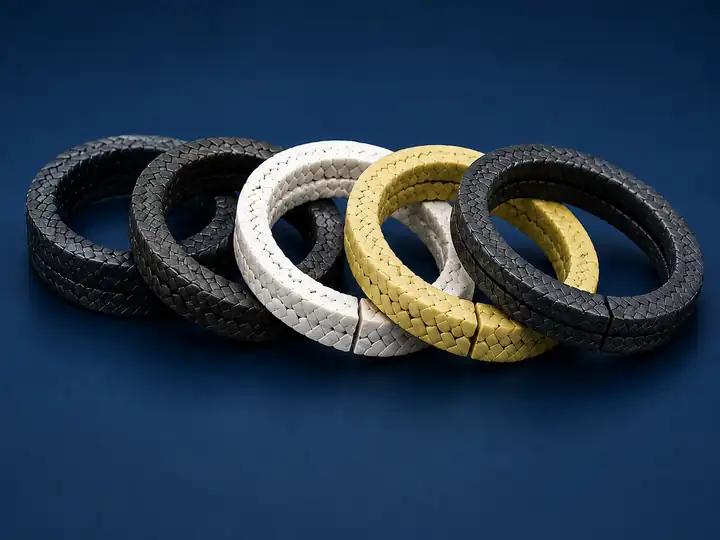
Die-formed packing rings: preformed split rings show the difference between field-cut spool stock and ring sets supplied to specified ring dimensions and density.
FIELD EXAMPLES
HOW CONSTRUCTION CHOICE CHANGES WITH THE PUMP
Equipment condition and service duty can change which construction is practical. Product limits still come from the specific packing style, materials and operating conditions.
EXAMPLE A
Older water pump with a worn sleeve
A comparatively conformable braid may tolerate minor surface irregularity better than a very dense structure. But visible scoring, excessive runout or a badly worn sleeve should be corrected rather than hidden with softer packing.
EXAMPLE B
High-speed centrifugal pump
The priority shifts toward low friction, heat control and a stable braid suited to rotary duty. A construction described as dense or high-pressure is not automatically better if it generates more heat at the actual shaft surface speed.
EXAMPLE C
Abrasive slurry service
Reinforced or hybrid constructions can add mechanical strength around the corners or surface. The trade-off is that hard reinforcement can increase sleeve wear if gland load, flush or alignment is wrong.
AVOID THESE ERRORS
COMMON MISTAKES WHEN COMPARING PUMP PACKING TYPES
01
Choosing by fiber name alone“Graphite packing” or “PTFE packing” does not tell you braid geometry, density, lubricant system or reinforcement.
02
Treating square braid as square cross-sectionThe outside shape and the internal braid method are different specifications.
03
Using discharge pressure as stuffing-box pressureThe pressure acting at the packing may be very different from pump discharge pressure because of pump geometry and flush arrangement.
04
Assuming denser means betterHigher density can improve stability or extrusion resistance but can also reduce conformability and increase friction in the wrong rotary service.
05
Ignoring the sleeve conditionNo packing construction can reliably compensate for severe wear, roughness, runout, gland misalignment or a damaged box.
06
Comparing catalog limits without contextTemperature, pressure and speed limits belong to a specific packing product and test basis; they are not universal limits for a construction family.
TERMINOLOGY
RELATED SEALING TERMS THAT ARE NOT PACKING CONSTRUCTIONS
Mechanical seal
A mechanical seal uses mating sealing faces and is a different shaft-sealing system, not a variety of compression packing.
Lantern ring
A lantern ring is a stuffing-box component that distributes flush or lubricant. It is installed within a packing set but is not itself pump packing.
Injectable packing
Injectable sealing compounds are used in some rotating equipment, but their installation and behavior differ from conventional braided compression-packing rings.
SELECTION PRINCIPLECONSTRUCTION ≠ MATERIAL
Braid geometry changes how packing compresses and conforms; fiber chemistry drives compatibility, temperature limits and much of the friction behavior.
SPEED EFFECTSURFACE SPEED, NOT RPM ALONE
At the same rpm, a larger shaft runs at a higher rubbing speed. Shaft diameter therefore matters directly when comparing heat generation and packing duty.
PRESSURE BASISUSE STUFFING-BOX PRESSURE
The packing set responds to the pressure acting in the stuffing box. Pump discharge pressure may be different and should not automatically be used as the packing design pressure.
HARDWARE LIMITPACKING CANNOT CORRECT RUNOUT
Sleeve wear, shaft runout, gland misalignment and damaged box surfaces can dominate leakage and packing life even when the packing type itself is suitable.