
Too little leakage
Leakage falls to near zero and the stuffing-box temperature rises after adjustment.
Check gland load, flush continuity and whether the packing has enough cooling.TROUBLESHOOTING GUIDE
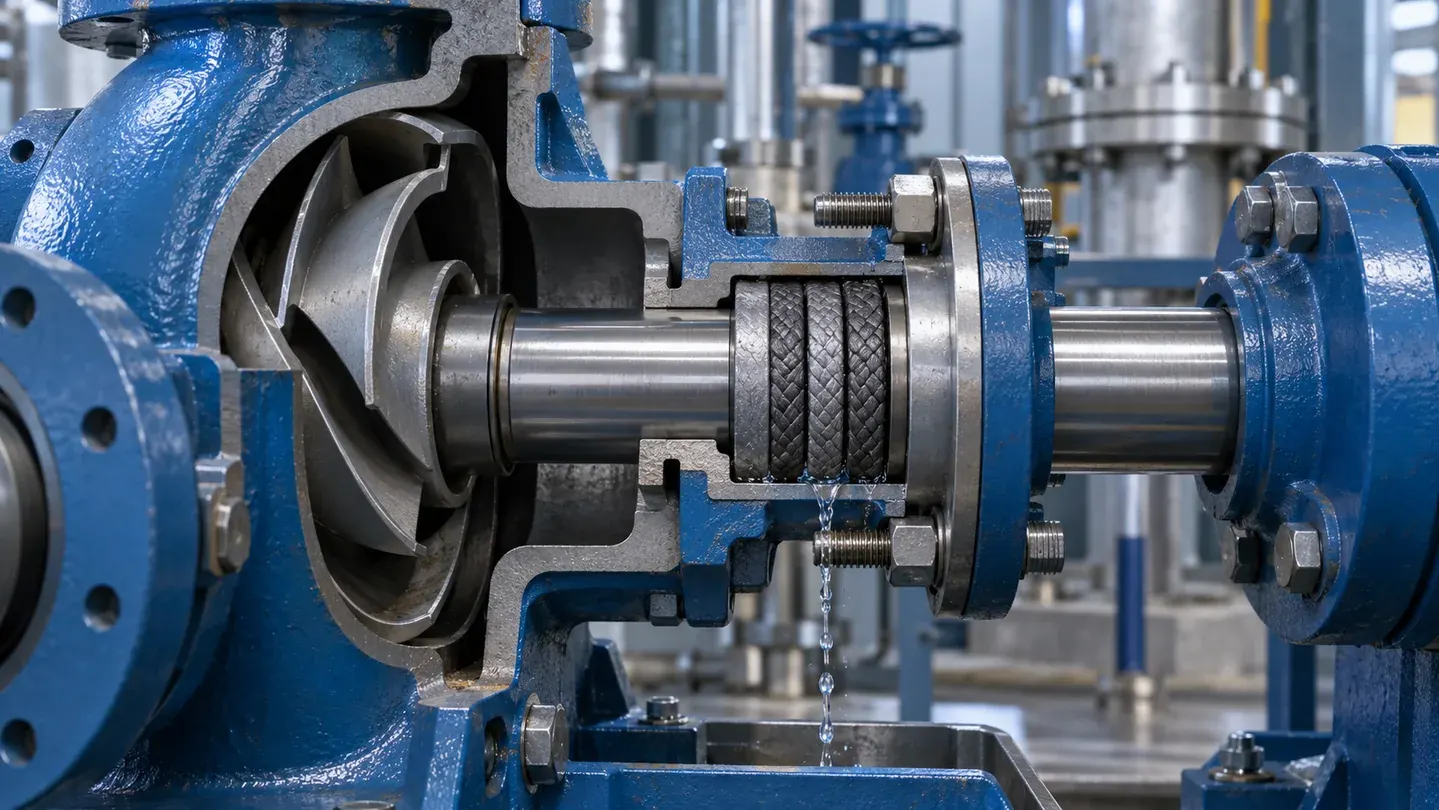
Compression packing normally needs a small, controlled leakage for lubrication and heat removal. The correct rate depends on the pump, shaft size, packing and stuffing-box duty—not one universal drip count.
QUICK ANSWER
Compression packing seals by controlled contact with the rotating shaft or sleeve. That contact creates friction and heat. A small amount of liquid at the interface provides lubrication and carries heat away. If the gland is tightened until the box becomes completely dry, the packing can overheat, harden and damage the sleeve.
A single leakage number does not fit every packed pump. Shaft or sleeve diameter, surface speed, local stuffing-box pressure, packing construction, the pumped liquid and any external flush all change the operating condition.
Use the exact pump or packing instructions first. When no application-specific value is available, published industry values can provide a starting reference, but the final adjustment still has to produce stable leakage without a rising temperature.
SYMPTOM MAP
Do not adjust from the drip count alone. Check temperature, follower position and flush condition at the same time.
Leakage falls to near zero and the stuffing-box temperature rises after adjustment.
Check gland load, flush continuity and whether the packing has enough cooling.The box stays cool but leakage remains excessive or increases rapidly.
Check ring fit, consolidation, follower travel, sleeve wear and box pressure.Liquid escapes mainly from one side or pulses with shaft movement.
Check follower squareness, runout, deflection and local sleeve damage.A fresh packing set may leak more while the rings seat during controlled run-in.
Reduce leakage gradually; do not make one large corrective gland movement.
LEAKAGE NUMBERS
Two approaches appear repeatedly in current pump and compression-packing guidance: a fixed drip-rate target for a defined pump arrangement, and a rate scaled to shaft or sleeve diameter. They answer the same maintenance question in different ways.
| Published approach | Typical value | What it means | How to use it |
|---|---|---|---|
| Fixed drip-rate target | About 40–60 drops/min appears in some current packed centrifugal-pump instructions after run-in | A simple operating target for a defined pump and packing arrangement | Apply it when it matches the pump/OEM guidance; do not treat it as universal |
| Diameter-based target | About 8–12 drops/min per inch of shaft or sleeve diameter appears in current industry guidance | Leakage scales with the size of the rubbing interface | Use as a starting reference, then confirm temperature and actual packing instructions |
| Initial break-in | Leakage is commonly higher while a new set beds in | The rings need cooling while they conform to the rotating surface | Reduce gradually in small equal gland adjustments after stabilization |
| Zero leakage | Not a normal target for conventional compression packing | Dry running can remove lubrication and cooling | If temperature rises as leakage disappears, correct the condition before tightening further |
FIELD MEASUREMENT
Measure only after the pump is at a stable operating point. A drip count taken during start-up or immediately after a gland adjustment can be misleading because the packing is still seating and the leakage rate is still changing.
| Step | What to do | Why it matters | Record with it |
|---|---|---|---|
| 1. Stabilize the pump | Run at the normal operating point and wait for the latest gland adjustment to stabilize | Packing responds gradually to compression and temperature | Flow or operating point, process temperature and flush condition |
| 2. Count visible drops | Count drops for 30–60 seconds and convert to drops per minute | A longer count reduces error from an irregular drip pattern | Whether leakage is uniform around the shaft or concentrated on one side |
| 3. Use volume for a stream | If leakage is too fast to count as individual drops, collect it for a timed interval and measure the volume | A continuous stream cannot be compared reliably by visual drip counting | Volume per minute and whether leakage is process fluid or external flush |
| 4. Measure temperature at the same point | Take repeat readings at the same gland or stuffing-box location | Leakage is acceptable only when the thermal trend is also stable | Temperature before and after each adjustment |
Measurement note: compare a field drip count only with a value based on the same method. A fixed drops-per-minute target and a diameter-based target are not interchangeable. For a specific pump, the OEM value takes priority over a generic packing guideline.
ADJUSTMENT METHOD
Record the baseline before touching the gland: leakage pattern, stuffing-box temperature, operating point and follower position.
Check the flush or sealing-liquid path where one is fitted. An open valve does not prove that clean fluid reaches the lantern-ring zone.
Adjust both gland nuts evenly and in small increments. Allow the packing to respond before changing the load again.
Judge each correction by leakage and temperature together. Lower leakage with a rising box temperature is not a successful adjustment.
If heavy leakage returns after a correctly adjusted set, inspect the sleeve, follower, ring size and installation rather than continuing to add gland load.
COMMON QUESTIONS
Enough to keep the interface lubricated and thermally stable. Fixed values such as 40–60 drops/min are used on some pumps, while other guidance scales at roughly 8–12 drops/min per inch of shaft diameter.
Exact pump and packing instructions take priority.Conventional compression packing commonly operates with controlled visible leakage rather than a completely dry stuffing box.
A sudden change in the pattern is a troubleshooting clue.A fresh set may leak more during run-in while the rings seat. Persistent excess leakage can also indicate wrong size, poor seating, low gland load or sleeve damage.
Make gradual adjustments only after the set stabilizes.Usually not. Zero leakage can remove cooling and drive friction up, causing overheating and sleeve wear.
Always read leakage and temperature together.For conventional compression packing, controlled leakage with a stable stuffing-box temperature is preferable to zero leakage with a rising temperature. If the pump manufacturer gives a leakage target, use that value rather than a generic rule.