
Excessive gland load
High contact pressure increases friction and raises the sleeve wear rate.
Check whether repeated tightening was used to chase leakage.TROUBLESHOOTING GUIDE
A worn sleeve changes the running surface the packing must seal against. Once grooves and scoring are established, new rings often cannot restore stable sealing by themselves.
QUICK ANSWER
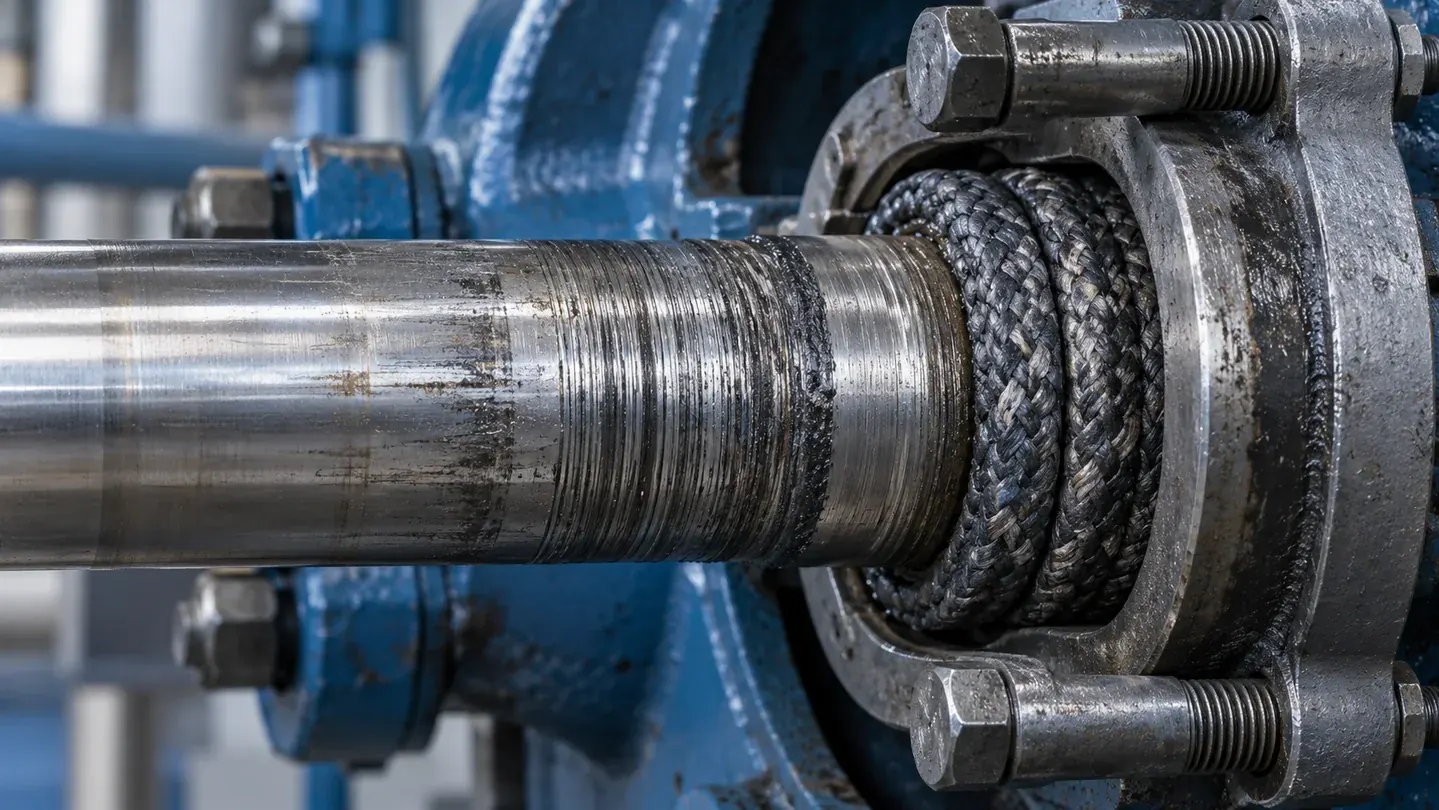
Compression packing seals by conforming to the rotating shaft or sleeve. A smooth and stable surface lets the ring set run with controlled leakage. Grooves, scoring, corrosion and excessive runout interrupt that contact, creating repeat leakage, local heat and short packing life.
Sleeve wear usually develops gradually. Operators often compensate by tightening the gland. That may reduce leakage briefly, but higher contact stress can deepen the wear track and accelerate the next failure.
A pronounced groove can become a leakage path by itself. In that condition, packing replacement alone may not restore normal operation; the sleeve may need repair or replacement.
WHY SLEEVES WEAR
High contact pressure increases friction and raises the sleeve wear rate.
Check whether repeated tightening was used to chase leakage.Solids trapped at the interface act like grinding media and cut grooves into the running surface.
Check the process solids path and whether clean exclusion flush is working.Runout, deflection or vibration concentrates packing load instead of distributing it evenly.
Cyclic leakage and uneven wear around the circumference are clues.A scratched or corroded sleeve damages the next packing set, which then accelerates sleeve wear again.
Inspect the full packing track before installing a new set.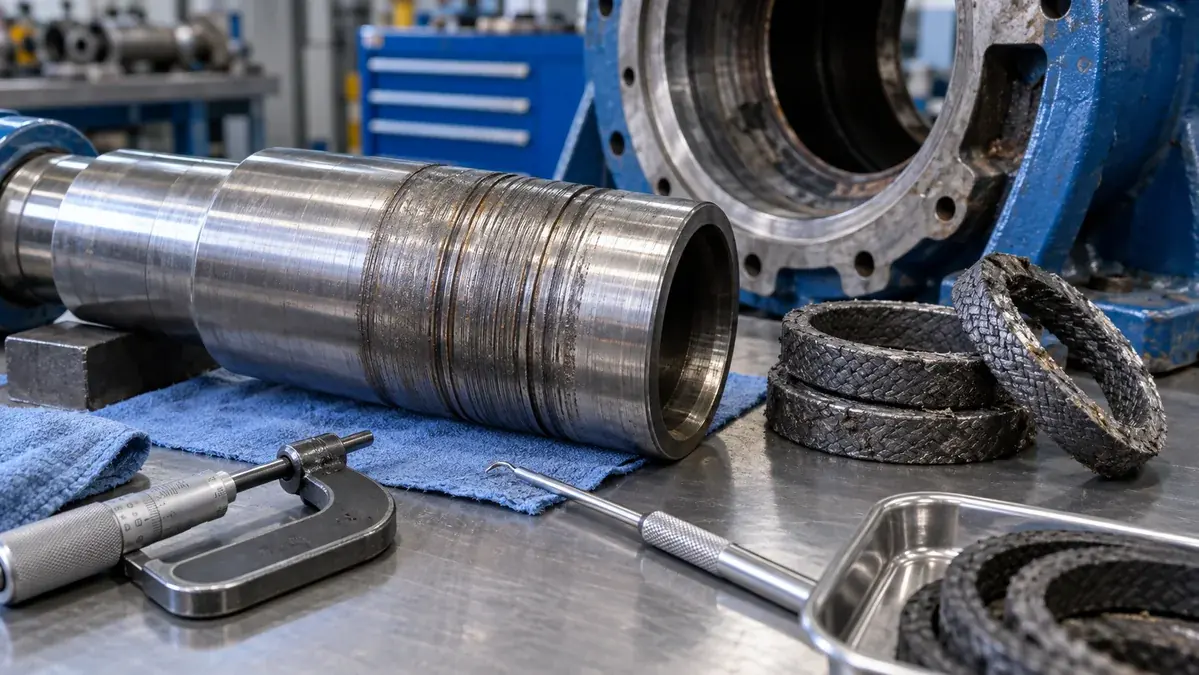
INSPECTION
| Observed surface | What it means | What to verify | Typical response |
|---|---|---|---|
| Light polishing only | Normal running track with no serious geometry loss | Surface remains smooth and continuous through the packing band | Proceed with repacking if the rest of the hardware is sound |
| Noticeable circumferential groove | The surface is no longer uniform enough for stable packing contact | Groove depth, width and history of repeat leakage | Repair or replace the sleeve before relying on new packing alone |
| Random scoring and scratches | Abrasive particles or debris moved through the interface | Flush cleanliness, process solids and removed-ring damage | Correct contamination and restore the running surface |
| Corrosion or pitting | The surface finish is chemically or environmentally damaged | Fluid compatibility and every liquid contacting the sleeve | Correct material compatibility and renew the damaged surface |
MEASURABLE CHECKS
Sleeve rejection limits are equipment-specific. Published packing guidance uses different runout and wear values, so the exact pump or sleeve specification must control the final decision.
| Check | Published example | What it tells you | How to use it |
|---|---|---|---|
| Shaft or sleeve runout | Published guidance varies: one packing reference uses about 0.002 in TIR as a general target, while another technical manual allows up to 0.005 in TIR for pumps | Different manufacturers use different equipment-condition criteria | Measure at the relevant running surface and apply the exact pump/OEM limit when one is specified |
| Deep circumferential groove | One published packing reference notes that grooves around 0.010 in or deeper can significantly reduce packing life | Established depth loss prevents even packing contact and accelerates repeat leakage | Treat the number as a troubleshooting reference, not a universal sleeve replacement limit |
| Longitudinal scoring | One packing technical manual recommends that longitudinal scores should not be present on a pump shaft or sleeve | A score crossing the packing contact can act as a direct leakage path | Inspect the full running band, not only the deepest circumferential groove |
| Surface condition after repacking | Rapid return of leakage with a correctly installed set is a practical sign that hardware condition may be controlling the seal | The new packing is conforming to the same damaged geometry | Stop adding gland load and inspect sleeve condition, runout and box hardware |
Use of these values: treat published packing numbers as screening references only. A specific limit from the pump manufacturer, sleeve drawing, repair procedure or plant engineering standard takes precedence for runout, surface finish and wear.
ACTION SEQUENCE
Expose and inspect the complete packing running band. Do not assume the sleeve is sound because the pump was recently repacked.
Compare sleeve wear with the removed-ring condition. Glazing plus grooves points toward heat; frayed rings plus scratches points toward abrasive contamination.
Review the gland-adjustment history. Repeated tightening to control leakage can turn a small wear track into a deep groove.
Check flush performance and solids exclusion before replacing the sleeve, or the new surface may be damaged by the same mechanism.
Only after the running surface is fit should a new packing set be installed and run in.
COMMON QUESTIONS
Yes. Packing is a rubbing seal. Excess gland load, heat, abrasives and poor shaft motion can turn normal contact into accelerated grooving or scoring.
Controlled leakage and clean flush conditions help limit wear.A lightly polished track may remain serviceable, but established grooves usually prevent a new set from making stable contact.
Inspect and measure the surface before installing new packing.If size and installation are correct, the rings may be trying to seal across old grooves, scoring, corrosion or excessive runout.
The rotating surface may be the actual problem.Common contributors include over-tightening, abrasive solids, long operation with damaged packing and shaft movement that concentrates load.
Find the wear mechanism before fitting the replacement sleeve.New packing cannot restore a damaged running surface. If an established groove is followed by rapid leakage after repacking, correct the sleeve condition before adding more gland load.