
Abrasive solids
Hard particles enter the interface, cut fibers and accelerate packing and sleeve wear.
Look for embedded solids and a dirty or ineffective flush path.TROUBLESHOOTING GUIDE
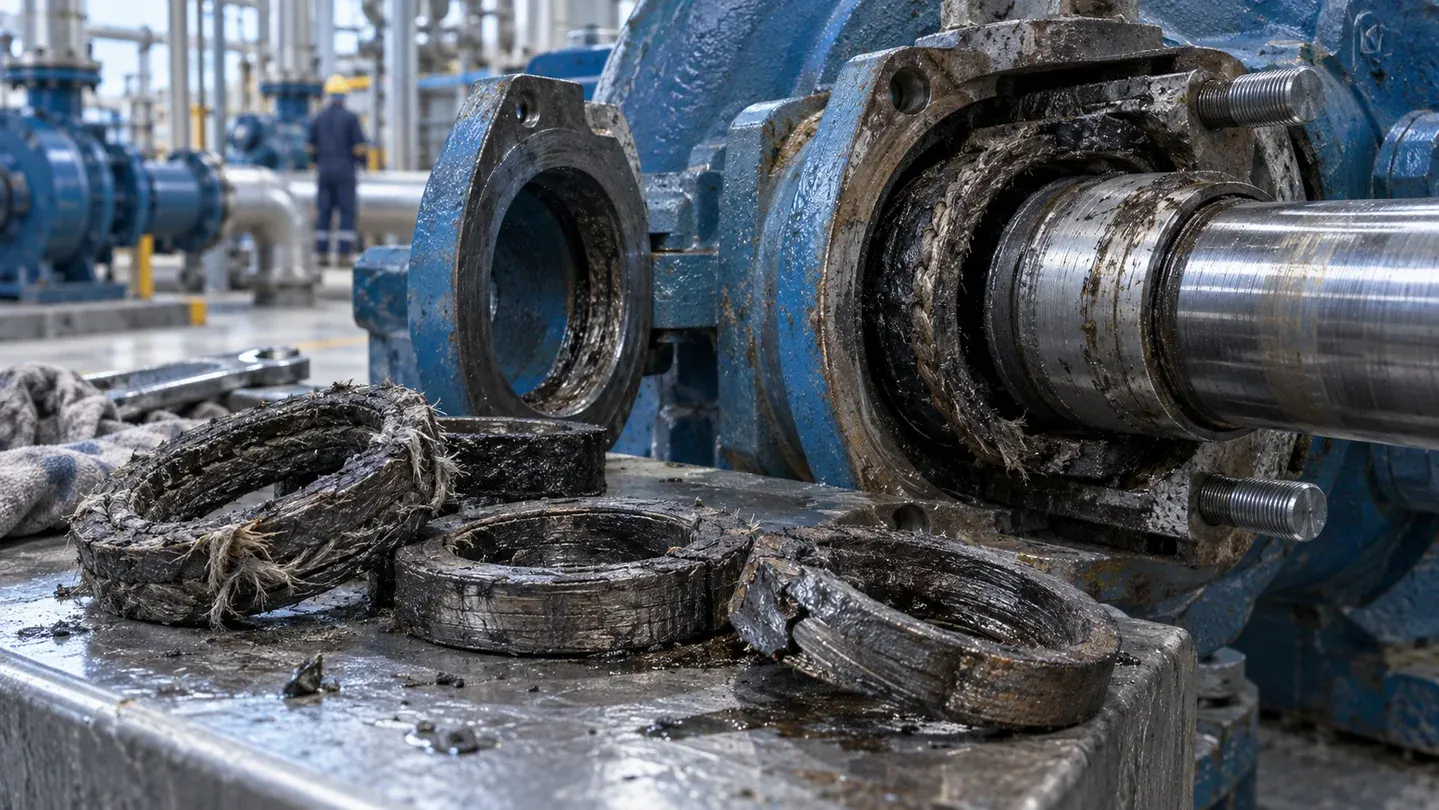
If packing fails after only a short run time, the root cause is usually not the ring set alone. Removed-ring evidence, sleeve condition and service history should be read together.
QUICK ANSWER
A packing set that lasts only hours, days or a few weeks is usually being damaged by installation, adjustment, hardware or the process environment. Common causes include abrasive solids, over-tight gland loading, sleeve grooves, shaft runout, blocked flush paths, wrong packing size and a material that does not match actual chemistry, temperature or surface speed.
Start with the removed ring set and keep the rings in order. Glazed inner surfaces point toward heat; cut fibers and embedded particles point toward abrasion; localized damage at one ring position points toward a local box or flush condition.
If the same failure returns after a carefully installed new set, stop treating the rings as the only problem. Repeated short life commonly exposes a sleeve, runout, clearance or flush fault that survived the last repack.
ROOT CAUSES
Hard particles enter the interface, cut fibers and accelerate packing and sleeve wear.
Look for embedded solids and a dirty or ineffective flush path.Over-tight packing runs hot, hardens and loses resilience before normal wear should end its life.
Look for glazing, heat-darkened rings and repeated gland tightening.Grooved sleeves, runout and distorted followers keep a new set from running evenly.
Look for one-sided wear and rapid leakage return after repacking.Material, construction, size or seating does not match the real duty or box geometry.
Check measured cross-section, ring preparation and actual process conditions.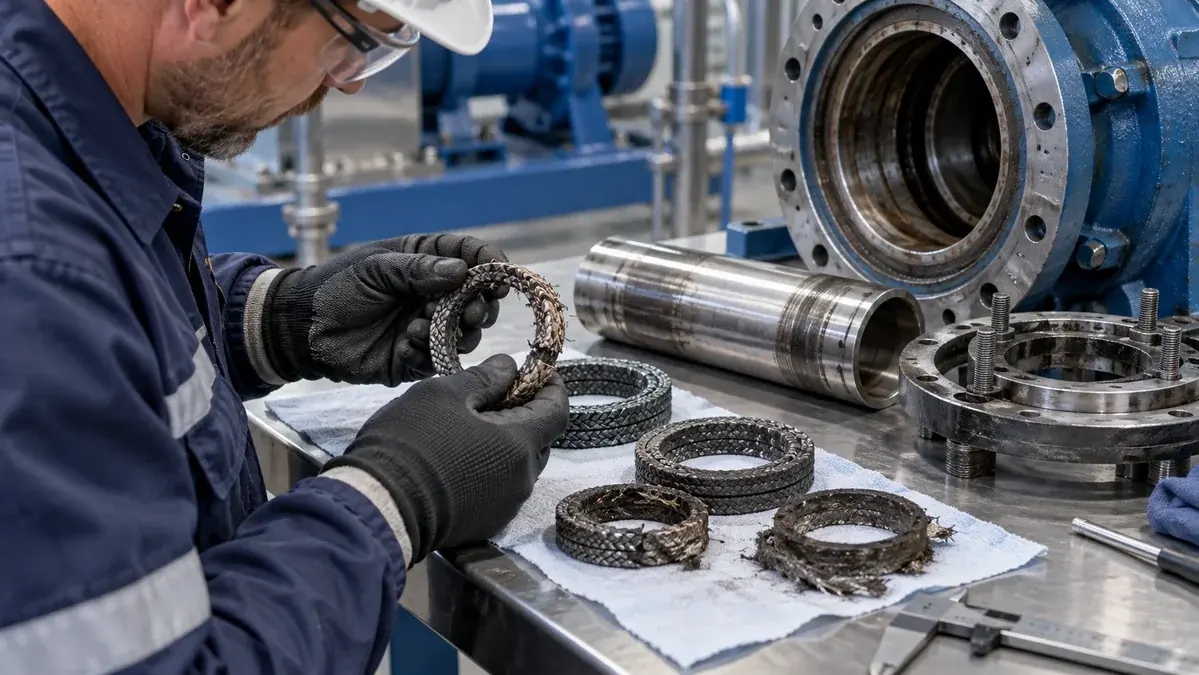
READ THE REMOVED RINGS
| Observed evidence | What it points to | What to verify | Response |
|---|---|---|---|
| Glazed, polished or hardened ID | Thermal damage from friction and insufficient cooling | Leakage history, gland load and flush availability | Correct the thermal condition before changing materials |
| Frayed fibers and embedded grit | Abrasive contamination at the running interface | Flush cleanliness, process solids and solids exclusion | Correct the contamination route and review abrasion resistance |
| One ring position badly damaged | A local box problem such as a groove, lantern-ring issue or pressure transition | Removal order and exact ring position | Fix the local condition instead of replacing the whole set blindly |
| Set uniformly flattened or crushed | Excessive compression or poor run-in discipline | Follower travel and adjustment history | Correct installation and loading rather than adding more compression |
| Soft, swollen or mushy rings | Chemical attack, incompatible process fluid, flush fluid or cleaning chemical | Every fluid that contacts the packing, not only the normal process liquid | Confirm compatibility before selecting the next packing material |
| Brittle, cracked or weak fibers | Thermal degradation, chemical incompatibility or loss of lubricant | Temperature history, chemistry and whether the set ran dry | Correct the damaging condition before changing construction or grade |
| Edges extruded or material missing | Excessive clearance, pressure or inadequate extrusion resistance | Gland, throat and lantern-ring clearances at the damaged ring position | Correct the supporting geometry and confirm packing suitability for pressure |
| Uneven compression around one ring | Cocked gland, runout, poor seating or distorted box hardware | Follower squareness, shaft motion and ring seating around the circumference | Correct the mechanical cause before the next repack |
FAILURE HISTORY
For each repack, record the same operating data. Use run time or operating hours between repacks and keep the observations consistent from one packing set to the next.
DIAGNOSTIC METHOD
Keep the removed rings in sequence so damage can be mapped back to the stuffing-box stack.
Inspect the shaft or sleeve before installing anything new. A fresh set on an established groove often reproduces the same failure.
Check the flush and the solids path. Abrasive service can destroy even correctly selected packing when clean exclusion flow is missing.
Reconstruct the last installation: measured size, cut length, seating, joint staggering and final lantern-ring position.
If the hardware and installation check out, compare the packing material and construction with the actual duty.
COMMON QUESTIONS
Early failure usually means heat, abrasives, wrong adjustment, a worn sleeve, shaft movement, poor flush or a duty mismatch is damaging the set.
Keep the old rings long enough to inspect the damage pattern.No fixed service-life target in hours applies to every pump. Speed, pressure, solids, chemistry, run time, sleeve condition, flush quality and gland adjustment all affect packing life.
Compare repeated failures on the same pump rather than using one generic number.Yes. Excessive load increases friction, drives temperature up and can harden the rings while accelerating sleeve wear.
Lower leakage is not an improvement if heat rises.If installation is correct, a recurring failure points toward an unchanged root cause such as sleeve grooves, runout, blocked flush or abrasive ingress.
If the cause is unchanged, the replacement set is likely to fail in the same way.Keep and inspect the failed rings. If the same damage pattern returns after a careful repack, correct the condition causing the damage before installing another set.